
Building a mobile app is only the beginning.
Once an application is launched, it needs ongoing maintenance to remain secure, compatible, reliable, and useful. Operating systems change. Phones change. APIs are updated. Security vulnerabilities are discovered. Apple and Google change their requirements. Users find bugs. Businesses request new features.
All of that creates ongoing costs.
So, how much does mobile app maintenance actually cost?
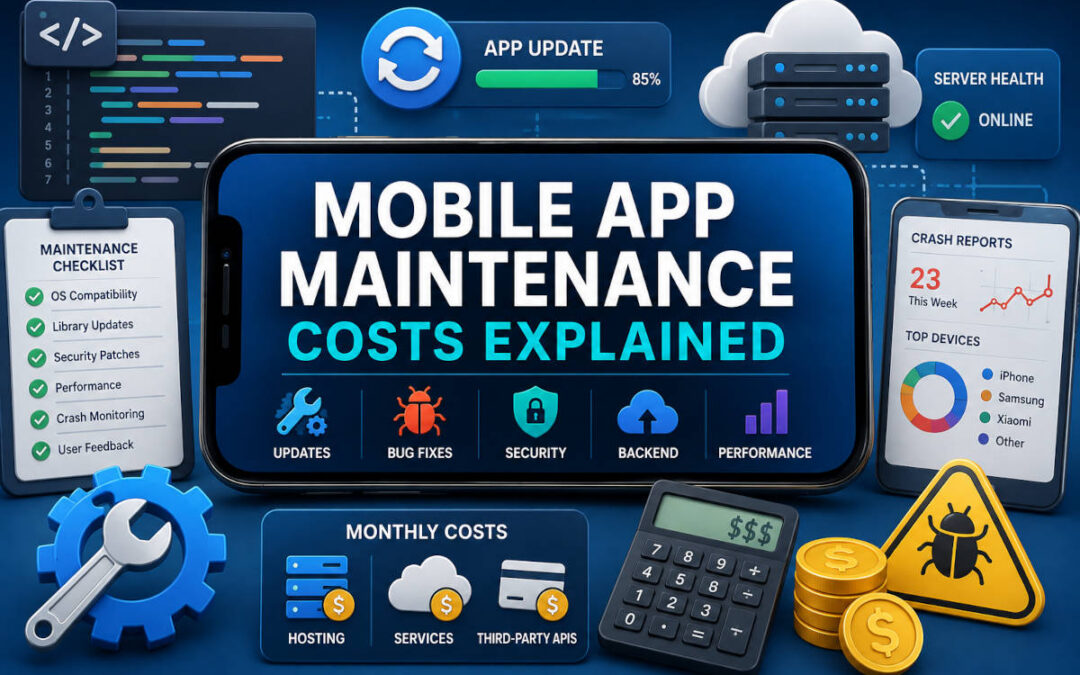
There is no single number that applies to every project, but businesses should usually expect to spend somewhere between 10% and 25% of the original development cost per year maintaining an application.
For some simple apps, the cost can be much lower. For complex business applications, maintenance can be significantly higher.
The important thing is understanding what you are actually paying for.
Why Do Mobile Apps Need Ongoing Maintenance?
A mobile app is not like a printed brochure that can remain unchanged for years.
It exists inside an ecosystem that is constantly changing.
Apple releases new versions of iOS. Google updates Android. Third-party services modify their APIs. Payment processors update security requirements. Cloud hosting environments change. Devices with different screen sizes and capabilities enter the market.
Even if your business never requests a new feature, the application may still need updates just to continue working properly.
Common maintenance tasks include:
- Fixing bugs
- Updating iOS compatibility
- Updating Android compatibility
- Updating third-party libraries
- Fixing API integrations
- Applying security patches
- Updating payment systems
- Monitoring servers
- Managing databases
- Updating push notifications
- Maintaining app store listings
- Improving performance
- Reviewing crash reports
- Testing new phone and tablet models
- Responding to Apple and Google policy changes
Some applications require only occasional attention.
Others need continuous development.
How Much Does Mobile App Maintenance Cost?
For a small application with limited functionality, maintenance might cost only a few hundred dollars per month.
A more typical business application may require anywhere from:
$500 to $2,000 per month
More complicated applications may cost:
$2,000 to $10,000+ per month
Large commercial platforms can obviously cost substantially more.
The number depends heavily on the complexity of the application and how actively the business is developing it.
It is also important to separate maintenance from new development.
Fixing compatibility issues and security vulnerabilities is maintenance.
Adding an entirely new customer portal or building a new reporting system is new development.
Businesses sometimes combine the two under the same maintenance budget, which can make the cost appear higher than it really is.
A Simple Mobile App May Be Inexpensive to Maintain
Consider a relatively simple application that:
- Displays company information
- Allows users to submit a few forms
- Sends notifications
- Connects to one or two APIs
- Has a basic customer login
If the application is stable and the business rarely changes it, there may not be much work required each month.
The development company might simply monitor the application, keep libraries updated, make occasional compatibility fixes, and handle operating-system updates.
For applications like this, businesses may spend relatively little on maintenance during quiet periods.
Complex Apps Cost More to Maintain
Now consider an application that includes:
- Thousands of users
- Real-time messaging
- Payments
- GPS tracking
- Maps
- Push notifications
- Multiple API integrations
- Cloud databases
- Image uploads
- Video
- Administrative dashboards
- Subscription billing
- Custom reporting
- Multiple user permission levels
There are many more pieces that can fail.
If Stripe changes something, the payment integration may need attention.
If Google changes an API, the mapping feature may need an update.
If Apple changes notification requirements, push notifications may need testing.
If the business changes how customers are billed, both the mobile application and backend may need modifications.
The more systems an application depends on, the more ongoing maintenance it generally requires.
iOS and Android Updates
One of the largest reasons mobile applications need maintenance is the constant evolution of iOS and Android.
Apple and Google release new operating-system versions regularly.
Most updates do not completely break existing applications, but they can introduce smaller problems.
An update could affect:
- Screen layouts
- Permissions
- Notifications
- Location services
- Camera access
- Photo libraries
- Bluetooth
- Background processes
- Authentication
- File storage
- Privacy settings
A development team may need to rebuild and test the application against newer operating-system versions.
Problems that appear minor can sometimes require significant changes behind the scenes.
This is one of the reasons completely abandoning a mobile app after launch is risky.
Third-Party Libraries Also Need Updates
Very few modern mobile applications are built entirely from scratch.
Developers use libraries and software frameworks for common functionality such as:
- Navigation
- Authentication
- Networking
- Image processing
- Analytics
- Payments
- Notifications
- Maps
- User interfaces
These libraries are updated continuously.
Older libraries may eventually stop working with newer versions of iOS, Android, Swift, Kotlin, React Native, Flutter, or other development tools.
Sometimes a library can simply be updated.
Other times an old library has been abandoned and needs to be replaced entirely.
This is particularly common when maintaining an application that has not been updated for several years.
API Maintenance Can Be a Major Cost
Many mobile applications are really front ends for other systems.
The app may connect to:
- A corporate database
- Salesforce
- HubSpot
- QuickBooks
- Stripe
- Google Maps
- Twilio
- OpenAI
- Inventory software
- Scheduling software
- Custom business systems
These connections are usually handled through APIs.
If the API changes, the mobile application may need to change with it.
Sometimes an API provider gives developers months of warning.
Other times a business discovers the problem because a feature suddenly stops working.
Applications with many outside integrations therefore tend to have higher ongoing maintenance costs.
Backend and Server Costs
Many mobile apps also require a backend.
The backend may handle:
- User accounts
- Database storage
- Authentication
- Payments
- Notifications
- Business rules
- File storage
- Reporting
- APIs
The mobile app itself may be downloaded from the App Store or Google Play, but the backend runs continuously on cloud infrastructure.
That can create separate expenses for services such as:
- Cloud hosting
- Databases
- File storage
- Content delivery
- SMS messages
- Push notifications
- Monitoring
- Backups
For a small application, these services may cost very little.
For an app with thousands or millions of users, infrastructure expenses can become substantial.
Bug Fixes
Every application has bugs.
Some are discovered immediately.
Others may not appear until a user performs an unusual combination of actions.
For example, a customer might:
- Begin uploading a photo.
- Lose their internet connection.
- Close the application.
- Reopen it.
- Attempt the upload again.
The developer may never have encountered that exact situation during normal testing.
Once a bug is identified, the development team has to reproduce it, determine the cause, fix the code, test the fix, and release an updated version of the application.
This work is a normal part of maintaining production software.
Security Maintenance
Security should also be considered part of ongoing mobile app maintenance.
New vulnerabilities are continually discovered in software libraries, operating systems, servers, and frameworks.
Applications that handle sensitive information require even greater attention.
Security maintenance might involve:
- Updating authentication systems
- Replacing vulnerable software libraries
- Rotating API credentials
- Updating encryption
- Reviewing server permissions
- Applying security patches
- Monitoring unusual activity
- Updating password requirements
- Improving access controls
Applications involving payments, healthcare, financial information, or confidential business data may require significantly more security work.
App Store Maintenance
Apple and Google also create maintenance work.
Mobile applications may occasionally need to be updated because of changes to App Store or Google Play requirements.
This could involve:
- Privacy disclosures
- Permission descriptions
- New SDK requirements
- Updated screenshots
- New device support
- Age ratings
- Content declarations
- Data collection disclosures
An application that hasn’t been updated in several years can sometimes require substantial work before Apple or Google will accept a new version.
Keeping the application reasonably current is usually easier than waiting until years of technical debt have accumulated.
Crash Monitoring and Analytics
A well-maintained application should also be monitored.
Crash-reporting systems can tell developers when the application unexpectedly closes on a user’s device.
Analytics can help identify:
- Which screens are being used
- Where users abandon the application
- Which devices experience problems
- Whether performance has slowed
- Which features are rarely used
Monitoring doesn’t necessarily require developers to constantly watch the application.
Instead, tools can automatically collect information that helps developers identify problems before they become major issues.
Maintenance Versus New Features
One of the most important distinctions when estimating costs is the difference between maintaining an app and improving it.
Maintenance might include:
- Fixing a broken login
- Updating a library
- Updating an API
- Fixing crashes
- Improving security
- Supporting a new iOS version
New development might include:
- Adding customer messaging
- Building a loyalty program
- Adding AI features
- Creating a subscription system
- Adding offline functionality
- Creating a new administrative dashboard
Businesses often continue adding features after an application launches.
That is completely normal.
But those costs should usually be considered ongoing product development rather than basic maintenance.
Should You Have a Monthly Maintenance Plan?
For many businesses, a monthly support agreement makes sense.
The development team can reserve a certain number of hours each month for:
- Bug fixes
- Updates
- Testing
- Small improvements
- Technical support
- Server maintenance
This makes monthly expenses more predictable.
It can also prevent the common problem of waiting until an application is badly outdated before addressing technical issues.
Another option is hourly maintenance.
The company simply contacts the developer whenever something needs to be changed.
That can work well for small and stable applications.
However, businesses should still make sure someone periodically reviews the app for compatibility and security updates.
What Happens If You Don’t Maintain an App?
Sometimes nothing happens for a long time.
That can create a false sense of security.
An application might continue running perfectly for two or three years without any major updates.
Then suddenly something changes.
A login service stops working.
An API is discontinued.
A new iOS version creates a problem.
A security vulnerability appears in an old library.
The application needs to be updated, but the development tools have changed so much that a simple fix turns into a significant upgrade project.
This is technical debt.
Small maintenance costs that were avoided over several years can eventually become a large modernization expense.
Older Apps Can Become Expensive to Update
We frequently see this with older software projects.
An application built several years ago may depend on:
- An outdated development framework
- Old server software
- Unsupported APIs
- Deprecated libraries
- Old database versions
- Outdated authentication methods
At some point, maintaining the original technology becomes more expensive than modernizing it.
In those situations, developers have to determine whether it makes more sense to:
- Update the existing application
- Replace individual components
- Upgrade the backend
- Migrate to a newer framework
- Rewrite part of the application
- Completely rebuild the application
That decision depends on the age, size, complexity, and condition of the existing codebase.
Can AI Reduce Mobile App Maintenance Costs?
AI is beginning to have a significant effect on application maintenance.
Modern AI coding tools can help developers:
- Find bugs
- Analyze error logs
- Update old code
- Replace deprecated functions
- Write tests
- Review code
- Update libraries
- Document systems
- Troubleshoot API problems
- Refactor applications
This can reduce the amount of time required for certain maintenance tasks.
AI is particularly useful when developers need to understand an unfamiliar or older codebase.
However, AI-generated fixes still need to be reviewed and tested.
Automatically changing production software without understanding the consequences can create more problems than it solves.
The best results generally come from combining experienced developers with modern AI development tools.
How Can Businesses Keep Maintenance Costs Down?
One of the best ways to reduce long-term maintenance costs is to think about maintenance during the original development process.
A well-designed app is usually easier and less expensive to maintain.
That means:
- Using widely supported technologies
- Avoiding unnecessary dependencies
- Keeping the code organized
- Documenting important systems
- Writing reusable components
- Building reliable APIs
- Keeping libraries updated
- Monitoring crashes
- Maintaining backups
- Updating the app regularly
Businesses should also avoid making an application more complicated than necessary.
Every additional integration, feature, and service potentially creates another component that must eventually be maintained.
Sometimes simpler software is better software.
How Much Should You Budget?
A reasonable starting point is to budget approximately 10% to 25% of the original development cost each year for basic maintenance and support.
For example, if an application originally cost $100,000 to develop, a business might budget:
$10,000 to $25,000 per year
That does not necessarily mean the business will spend that entire amount.
It provides room for normal updates, bug fixes, compatibility work, and infrastructure changes.
If the company plans to continually add features, the development budget should be higher.
A growing application is essentially an ongoing software development project.
Don’t Forget About Hosting and Third-Party Fees
Developer maintenance is only one part of the cost of operating an app.
Depending on the application, there may also be recurring expenses for:
- Web hosting
- Cloud servers
- Databases
- File storage
- Email services
- SMS messaging
- Maps
- AI APIs
- Payment processing
- Analytics
- Customer support platforms
- Domain names
- Monitoring tools
- Apple Developer accounts
- Other third-party software
Some services have flat monthly fees.
Others charge based on usage.
An application with 100 users may therefore cost very little to operate, while the same application with 100,000 users could have significant infrastructure costs.
The Bottom Line
Mobile app maintenance should be considered part of the cost of owning an application.
Launching the app is not the end of the project.
A successful mobile application needs to remain compatible with new devices, operating systems, APIs, security requirements, and changing business needs.
For most businesses, budgeting around 10% to 25% of the original development cost annually is a reasonable starting point.
Simple applications may cost much less.
Large or rapidly evolving applications may cost considerably more.
The key is to maintain the software consistently instead of allowing years of technical debt to accumulate.
A properly maintained mobile app should not require constant expensive repairs.
It should receive smaller, manageable updates over time that keep it secure, reliable, and useful.
In many cases, regular maintenance is considerably less expensive than ignoring an application for several years and eventually being forced into an emergency rebuild.
Contact Code Team Blue Today for your Mobile App Maintenance Needs