Software-as-a-Service products have become an essential part of modern business.
Companies use SaaS platforms for accounting, customer relationship management, project management, email marketing, scheduling, inventory, document storage, analytics, and hundreds of other business functions.
In many situations, SaaS is the right choice.
You can create an account, enter a credit card, configure a few settings, and start using the software almost immediately.
But SaaS has limitations.
As a business grows, it may eventually find itself changing its processes to accommodate the software instead of using software that matches the way the business actually operates.
That is where custom software becomes attractive.
Custom software is designed specifically around a company’s processes, employees, customers, data, and business rules.
So, what makes custom software better than SaaS?
The biggest difference is simple:
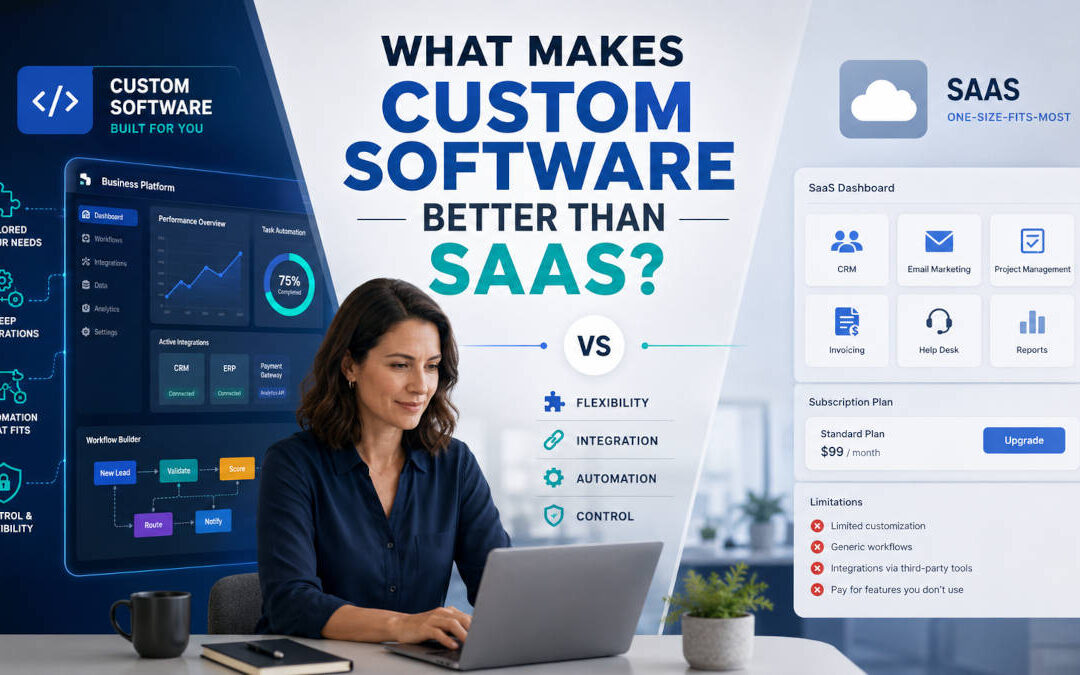
SaaS requires your business to adapt to the software. Custom software can be built to adapt to your business.
What Is SaaS?
SaaS stands for Software as a Service.
Instead of purchasing and installing software on your own servers, you typically pay a monthly or annual subscription to access software hosted by another company.
Common examples include:
- Customer relationship management systems
- Accounting platforms
- Project management tools
- Email marketing systems
- Scheduling software
- Help desk systems
- File sharing platforms
- E-commerce tools
- Human resources software
- Inventory systems
SaaS products are usually designed to serve thousands or even millions of customers.
Because of that, they have to work reasonably well for many different businesses.
That is both their greatest strength and one of their biggest weaknesses.
What Is Custom Software?
Custom software is built specifically for one business or organization.
It could be:
- A web application
- A mobile app
- An internal company portal
- A customer portal
- An inventory system
- A scheduling platform
- A reporting system
- A workflow automation tool
- A CRM
- An inspection application
- A field service system
- A custom API
- A combination of several systems
Instead of starting with a generic product and configuring it, developers start with the business requirements.
The software is then designed around those requirements.
That difference can become extremely important for companies with specialized workflows.
Custom Software Matches Your Workflow
One of the biggest advantages of custom software is that it can mirror the way your company already operates.
Imagine a company has a process that looks like this:
- A customer requests a quote.
- A salesperson reviews the request.
- The request is assigned to an estimator.
- Photos and documents are uploaded.
- Pricing is generated based on several internal rules.
- A manager approves the estimate.
- The customer receives the proposal.
- The approved project is transferred to production.
- Accounting receives the billing information.
A generic SaaS platform may handle some of these steps.
It may handle most of them.
But there is often one point where employees have to create spreadsheets, send emails, copy information between systems, or manually work around the software.
Custom software can be built around the entire process.
Instead of changing the business to match the software, the software matches the business.
You Can Eliminate Unnecessary Features
SaaS products often contain hundreds of features because they have to serve many different types of customers.
Your company might only use 20% of them.
That can make software unnecessarily complicated.
Employees may have to navigate through menus, screens, settings, and options that have nothing to do with their jobs.
Custom software can be much simpler.
An employee can log in and see exactly what they need to do.
For example:
- Today’s work orders
- Pending approvals
- Customer messages
- Inventory alerts
- Assigned projects
Nothing more.
A simpler interface can reduce training time and employee mistakes.
Custom Software Can Connect Your Existing Systems
Businesses rarely operate with only one piece of software.
A company might use:
- QuickBooks
- Salesforce
- HubSpot
- Stripe
- Google Workspace
- Microsoft 365
- Twilio
- Shopify
- WooCommerce
- A shipping provider
- A legacy database
- An industry-specific platform
The problem is that these systems do not always communicate with each other.
Employees end up moving information manually.
A custom application can act as the bridge between them.
For example, a custom system could automatically:
- Import a new lead from a website.
- Create the customer inside a CRM.
- Generate an estimate.
- Collect a payment.
- Create an accounting record.
- Send a notification.
- Update an inventory system.
- Schedule a service appointment.
This type of integration can eliminate large amounts of repetitive administrative work.
You Own the Software
Ownership is another major difference.
With SaaS, you are renting access to someone else’s software.
The SaaS company controls:
- The platform
- The features
- The interface
- The pricing
- The update schedule
- The terms of service
- The supported integrations
- The future direction of the product
With custom software, the business can own the application and usually the source code, depending on the development agreement.
That provides significantly more control.
If the company wants a new feature, it can build it.
If it wants to change hosting providers, it may be able to move the application.
If it wants to integrate with a new service, developers can add the integration.
The business is not waiting for a software vendor to decide whether a requested feature is worth building.
SaaS Pricing Can Become Expensive as You Grow
SaaS often looks inexpensive when a company is small.
Maybe the software costs $30 or $50 per user each month.
For five employees, that is not a major expense.
But what happens when the company has 100 employees?
A product that costs $75 per user per month would cost:
$7,500 per month
or:
$90,000 per year
And that may be only one SaaS platform.
A company might also pay for:
- CRM software
- Scheduling software
- Reporting software
- Document management
- Project management
- Customer support software
- Marketing automation
- Inventory software
At some point, custom development can become financially attractive.
The initial development cost is higher, but the business may avoid years of increasing per-user subscription fees.
Custom Software Can Combine Several SaaS Products
Another common problem is SaaS overload.
A company might start with one service for customer management.
Then it adds another service for scheduling.
Another for reporting.
Another for file storage.
Another for customer communication.
Another for payments.
Soon employees are switching between six different browser tabs just to complete one transaction.
Custom software can sometimes combine these processes into a single interface.
The custom application does not necessarily have to replace every SaaS platform.
It can sit above them.
For example, employees might interact with one custom dashboard while the system quietly exchanges information with QuickBooks, Stripe, HubSpot, and other services behind the scenes.
That can give employees a custom workflow without requiring the company to rebuild every underlying system.
Custom Software Can Automate More of Your Business
Automation is another major advantage.
Generic SaaS software usually automates common workflows.
Custom software can automate your workflows.
That might include unusual business rules such as:
- Assigning projects based on geography
- Calculating pricing based on customer contracts
- Creating reports based on industry-specific requirements
- Routing approvals based on transaction size
- Generating documents automatically
- Sending alerts when certain conditions occur
- Moving information between departments
- Scheduling employees based on certifications
- Calculating commissions
- Managing specialized inventory
These may sound like small improvements.
But when a task is repeated hundreds or thousands of times every year, even saving a few minutes per transaction can create substantial savings.
Custom Software Can Create a Competitive Advantage
SaaS gives your competitors access to the same tools you have.
That is not necessarily bad.
There is usually no strategic advantage in building your own email system or accounting software.
But certain business processes may be different.
Suppose your company develops a custom system that allows employees to complete jobs 30% faster than competitors.
Or maybe customers can receive estimates instantly while competitors take two days.
Perhaps your system automatically analyzes customer information and recommends the next service.
Those capabilities can become part of the company’s competitive advantage.
A custom application can effectively become intellectual property.
Instead of simply purchasing software that everyone else can use, the company is developing technology around the way it does business.
Better Reporting and Data Access
Reporting is another area where SaaS limitations frequently become frustrating.
A SaaS product may contain plenty of reports.
Unfortunately, it may not contain the exact report your management team needs.
Companies often end up exporting data into Excel and manually creating reports.
Custom software can create reporting around the business.
Managers could have dashboards showing:
- Revenue
- Sales activity
- Production status
- Employee performance
- Customer retention
- Inventory
- Project profitability
- Outstanding invoices
- Service response times
The information can also come from multiple systems.
Instead of logging into several platforms, management can have one dashboard that combines the important information.
More Control Over Your Data
Data control is another important consideration.
With many SaaS products, your business data is stored inside someone else’s platform.
Most reputable SaaS providers offer tools for exporting information.
However, those exports do not always contain everything in a convenient format.
Custom software can give the business much more control over:
- Database structure
- Backups
- Data retention
- Reporting
- Exports
- Integrations
- Access permissions
The company can decide exactly how its information is stored and used.
This can be particularly important for businesses that consider their operational data valuable.
Custom Software Can Support Unique Security Requirements
SaaS platforms usually provide strong security features because they serve large numbers of customers.
However, businesses sometimes have security requirements that do not fit neatly into a standard product.
Custom software can implement specialized controls such as:
- Custom user roles
- Department-specific access
- IP restrictions
- Multi-factor authentication
- Approval workflows
- Detailed audit logs
- Custom password policies
- Private network access
- Single sign-on
- Data encryption
- Custom session rules
The important distinction is flexibility.
The security system can be designed around the organization’s actual risk and compliance requirements.
You Control the Upgrade Schedule
SaaS companies constantly update their products.
Usually, that is a benefit.
You automatically receive improvements and security updates.
But it can also create problems.
A vendor might:
- Change the interface
- Remove a feature
- Change an API
- Modify pricing
- Deprecate an integration
- Redesign a workflow
- Discontinue a product
Your company has very little control over those decisions.
With custom software, you decide when major changes happen.
You can test updates before deploying them.
You can keep important workflows consistent for employees.
That level of control can be valuable for companies with complicated operational processes.
Custom Software Can Work With Legacy Systems
Many established businesses still depend on older systems.
That could include:
- Old databases
- Mainframe applications
- Legacy PHP systems
- Older ERP software
- Manufacturing systems
- Custom accounting applications
Replacing everything may be unrealistic.
A modern custom application can sometimes provide a new interface while continuing to communicate with the older system.
This can allow a company to modernize gradually rather than attempting an expensive complete replacement.
It can also extend the usable life of important business systems.
Custom Software Can Grow With the Business
Another benefit is the ability to control how the application evolves.
A company does not necessarily need to build everything at once.
A custom application might begin with:
Phase One
Customer accounts and project tracking.
Then add:
Phase Two
Scheduling and employee management.
Then:
Phase Three
Billing and payment integration.
Then:
Phase Four
AI-powered reporting and automation.
This allows the business to spread development costs over time while continuously improving the platform.
Where SaaS Is Better
Custom software is not automatically the right solution.
There are plenty of situations where SaaS is better.
For example, most small businesses probably do not need to build their own:
- Email system
- Accounting platform
- Video conferencing software
- Cloud storage platform
- Payroll system
Existing SaaS products already solve these problems extremely well.
SaaS is usually attractive when:
- The business has standard requirements.
- A mature product already solves the problem.
- The company needs something immediately.
- The number of users is small.
- Customization is not important.
- The subscription cost is reasonable.
There is little reason to spend $100,000 developing something that an existing product already does perfectly well for $100 per month.
When Does Custom Software Make Sense?
Custom development becomes more attractive when several of these conditions exist:
- Your workflow is unusual.
- Employees constantly work around existing software.
- You are entering the same data into multiple systems.
- SaaS licensing costs are becoming expensive.
- You need several platforms to complete one process.
- Existing software cannot provide required reports.
- Your company needs unique integrations.
- You have complicated business rules.
- Software can give your company a competitive advantage.
- You want greater ownership and control.
One of the biggest warning signs is when employees start maintaining large spreadsheets around a SaaS product.
That usually indicates that the existing software does not fully match the company’s workflow.
You Don’t Always Have to Choose One or the Other
One of the most useful approaches is combining custom software with SaaS.
For example, a company might build its own custom operations platform but continue using:
- Stripe for payments
- QuickBooks for accounting
- Twilio for text messaging
- HubSpot for marketing
- Google Maps for mapping
- OpenAI for AI functionality
The custom application becomes the system that connects everything.
This approach avoids rebuilding technology that already works well while still giving the company a customized workflow.
In many cases, this hybrid model provides the best balance between cost, flexibility, and control.
Can AI Make Custom Software More Affordable?
AI is also beginning to change the economics of custom software development.
Modern AI coding tools can help developers:
- Generate application code
- Create user interfaces
- Build database queries
- Write API integrations
- Debug problems
- Create automated tests
- Refactor existing code
- Generate documentation
This can reduce the time required to develop certain types of applications.
It also means smaller businesses may increasingly be able to justify custom development for projects that would previously have been too expensive.
AI does not eliminate the need for experienced developers.
Someone still needs to understand the business requirements, design the system, review the generated code, manage security, test the application, and deploy it.
But AI can make an experienced development team considerably more productive.
SaaS Versus Custom Software: A Simple Comparison
SaaS
Advantages
- Lower upfront cost
- Fast implementation
- Vendor handles hosting
- Vendor manages updates
- Mature features
- Predictable subscription pricing
Disadvantages
- Limited customization
- Monthly or annual fees
- Per-user pricing
- Vendor controls features
- Vendor controls pricing
- May not match your workflow
- Integration limitations
Custom Software
Advantages
- Built around your business
- Complete customization
- Greater control
- Can automate unique processes
- Can integrate multiple systems
- No required per-user SaaS licensing
- Can become a competitive advantage
Disadvantages
- Higher upfront cost
- Requires development
- Requires maintenance
- Takes longer to launch
- Requires technical management
Neither approach is universally better.
The correct choice depends on the business problem.
The Bottom Line
SaaS is excellent when your business needs are similar to everyone else’s.
Custom software becomes valuable when your business is different.
If employees constantly adapt their processes to software, manually transfer information between systems, maintain complicated spreadsheets, or pay for multiple platforms that still do not quite solve the problem, it may be time to consider custom development.
The biggest advantage of custom software is not simply that you own it.
It is that the application can be designed around the way your company actually operates.
That can mean:
- Fewer manual tasks
- Faster workflows
- Better reporting
- Easier integrations
- Greater control
- Lower long-term licensing costs
- Better customer experiences
SaaS gives businesses access to powerful software quickly and inexpensively.
Custom software gives businesses the opportunity to build technology specifically around what makes them different.
For the right company and the right business process, that difference can be worth considerably more than the cost of development.